Asian Textile Studies
Contents
Ata Déi Textiles - 1
Introduction
Cotton and its Preparation
Natural Dyeing
Binding and Weaving
Ata Déi Textiles - 2
Women's and Men's Costume
Petak Alé
Petak Harén
Petak Harén Nai Telu
Petak Harén Nai Rua
Petak Kwae Tuan
Petak Hareen Nai Léém
Men's Costume
Bibliography
Introduction
Because of its isolation, the women of the Ata Déi Peninsula have maintained their textile making traditions for longer than those living in the island’s other weaving regions.
Ernst and Hanna Vatter were the earliest collectors to visit Ata Déi, riding to the village of Lewokoba, located north of Watuwawer, in June 1929. There they collected a three-panel ‘petak harin’ (meaning good sarong) that had been made by a member of the Lamahaku clan.
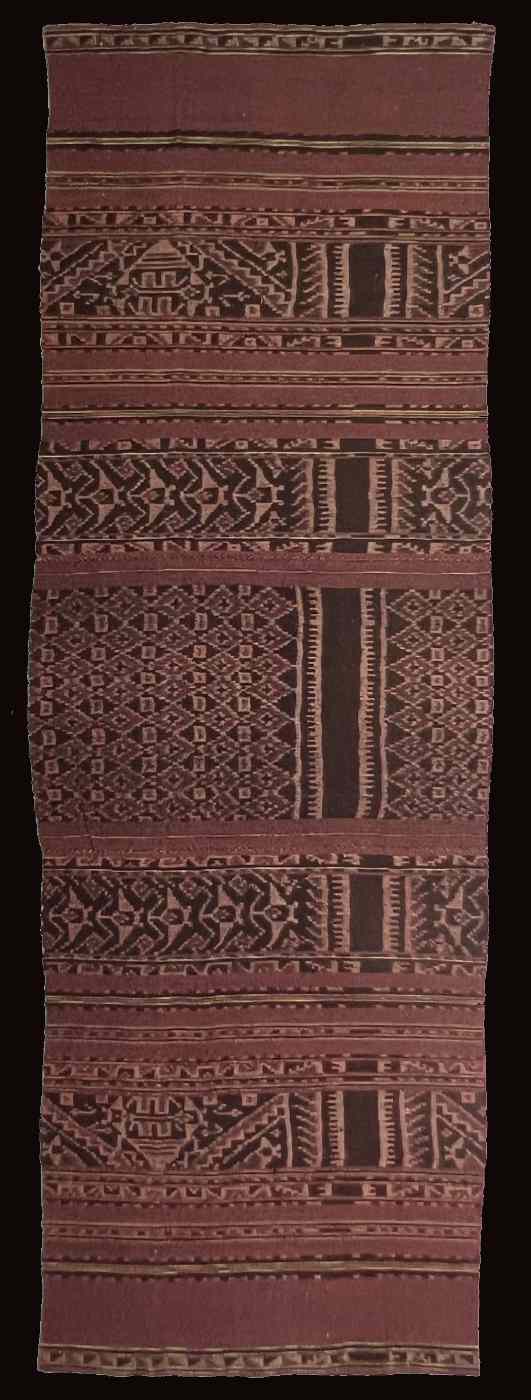
The ‘petak harin’ sarong collected in Lewokoba by Ernst Vatter in June 1929
Very similar sarongs are still being made on Ata Déi today
Today for everyday wear, the majority of women and girls still wear locally made ikat sarongs, although many of these are now made using commercial yarns and synthetic dyes. Even so, most women also own a naturally dyed hand-spun sarong for ceremonies or for attending church. Most of the women we have talked to say they have woven a number of traditional three-panel adat cloths. For example, the mother-in-law of the kepala desa of Lerek told us that she had woven fourteen, while in Watuwawer, Martha Mua Lejap who was born in 1946 said that following the birth of her first child in 1975 she had completed a petak harén bridewealth sarong every year. Apparently, many other local women are just as productive.
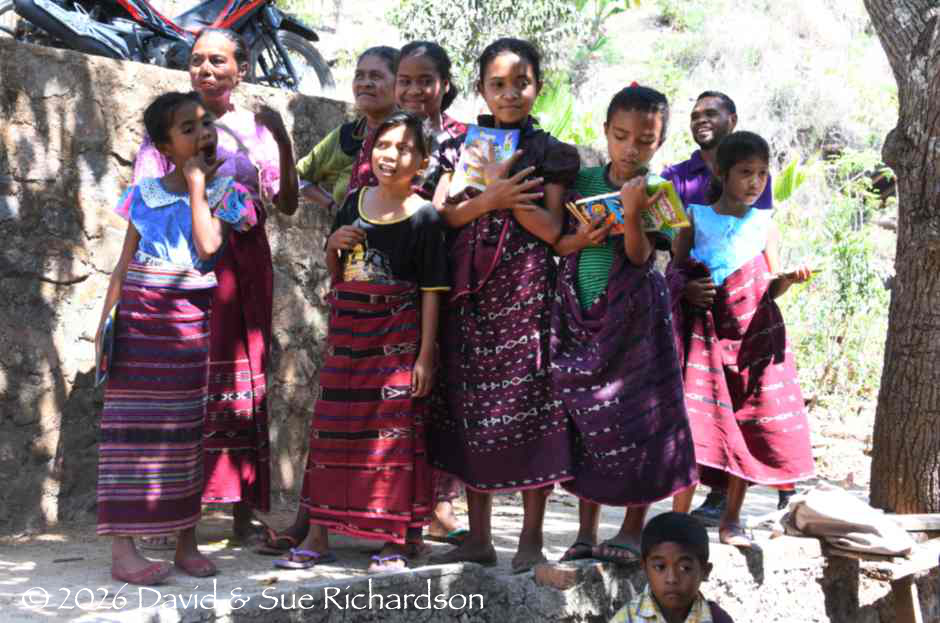
Three women and five girls in Atawolo, all wearing locally made sarongs
The cultivation of locally grown cotton continues and many women and girls are still proficient at using the drop spindle. Although chemical dyes have become widely popular, many women still know how to dye indigo and morinda, along with a number of other natural dyes. This means that there are still many weavers continuing to produce traditional hand-spun naturally dyed sarongs, although the quality of the ikat binding varies from weaver to weaver. Most of these are made for local consumption not for trade, for use in marriage gift exchange or to give or sell to relatives.
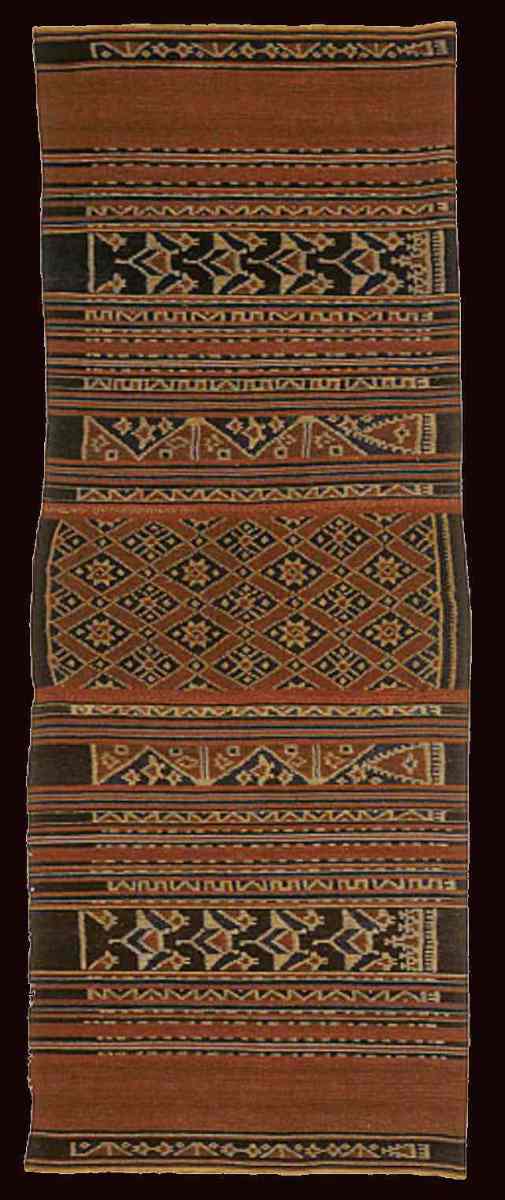
A woman’s sarong from Ata Déi. National Gallery of Australia.
Although the traditional women’s textiles of Ata Déi have some similarities to those of Lamalera they are still quite distinctive. They mostly have deep, rich tones of brown and dark grey and tend to be very heavy.
Return to Top
Cotton and its Preparation
Many women on the Ata Déi Peninsula are still proficient in processing their own cotton, known as lélu. For example, Atawalo with 140 households has 60 weavers, all of who can drop spin.
The women cultivate tree cotton, Gossypium arboreum, in their own gardens, where it grows well in the local climate. The cotton plant is locally known as kapek lolon (Fricke 2019, 77). Cottonseed recovered from the previous harvest is planted towards the end of the rainy season, around February, and the bols are harvested between June and August.
One of the attributes of tree cotton is that it sometimes reverts to a hardier ancestral variety bearing light rust-coloured fibres, a feature shared with all wild uncultivated cottons. This is highly valued because local weavers use this so-called red cotton in their textiles.
The bols are first dried and then ginned using a locally made device with counter-rotating rollers known either as a béa or a malok. The seeds are retained so that they can be planted later. The fibres are then cleaned by hand and then aerated by beating them with either thin sticks or a bow (bus or buser).
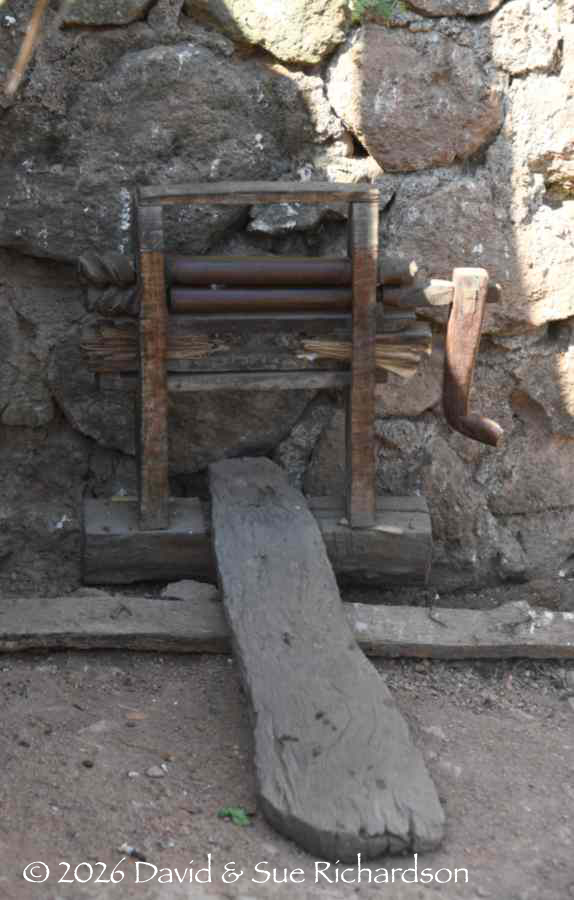
An old béa or malok hand-operated gin
On Ata Déi all of the women spin their yarn using a wooden kaduke or kduuk drop spindle rather than a hand-operated spinning wheel. The drop spindle consists of a round spindle or axle and a lower whorl, both generally made of a hard wood to store angular momentum. As elsewhere on Lembata Island, the drop spindle is unusually long. Weavers tell us that such a spindle is preferred because it spins perpendicular and does not precess like a spinning top – its rotational axis remains vertical and is less likely to wobble. This produces a more even twist. Using a drop spindle also allows the spinner to adjust the width of the yarn from coarse to fine.
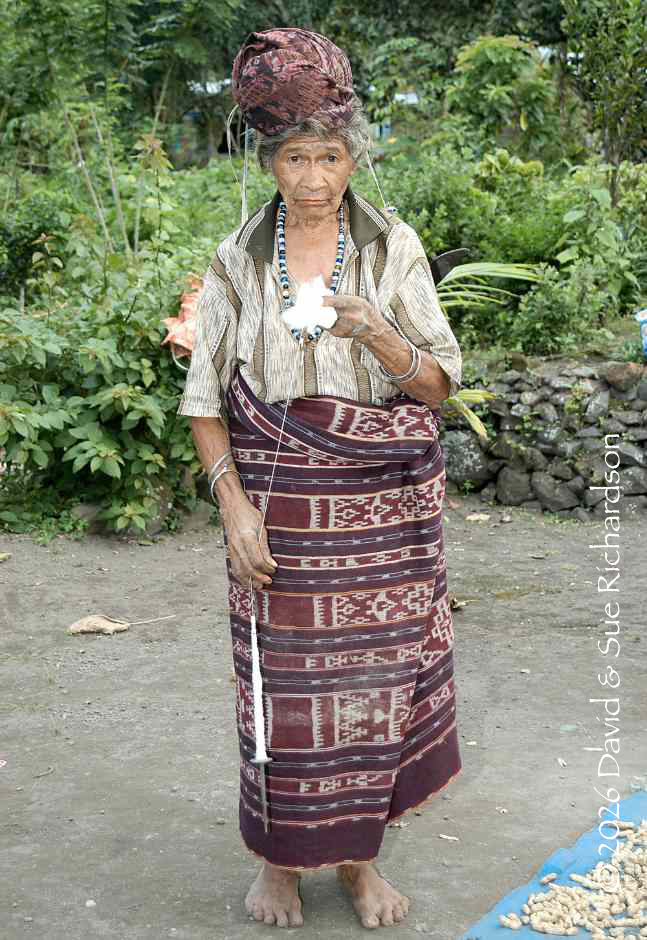
Above: An elderly lady drop spinning in Lerek in 2004
Below: Mama Lucia drop spinning in Watuwawer in 2017
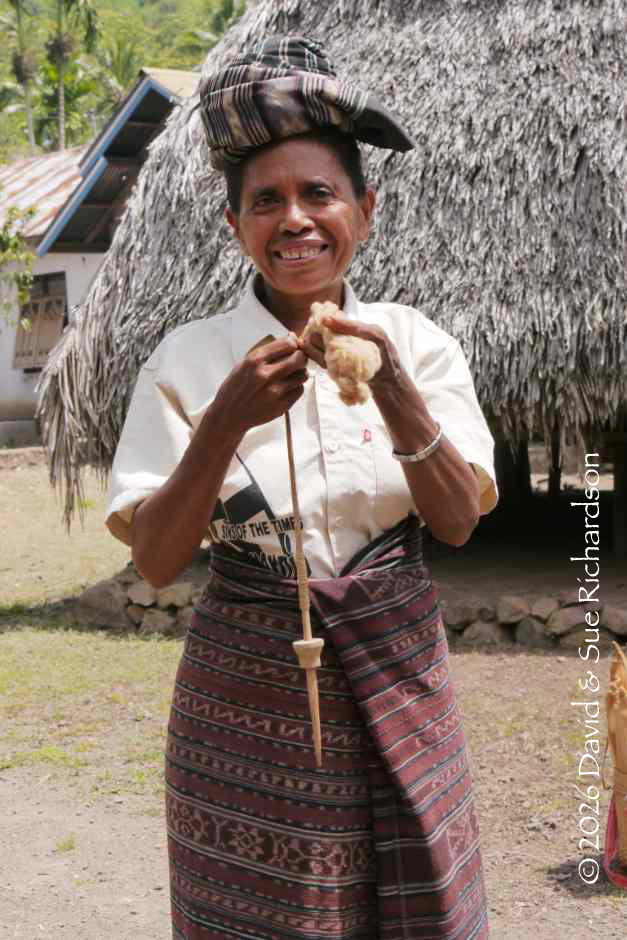
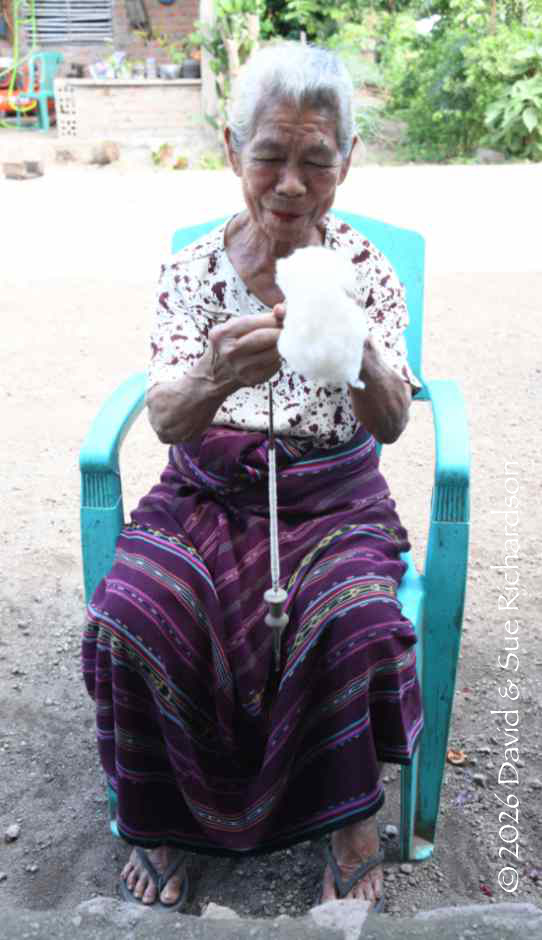
An elderly lady drop spinning in Watuwawer in 2025
The production of a hand-spun sarong requires a considerable quantity of yarn. Consequently, women use all of their free time drop spinning, whether walking around the village, talking to friends or just sitting outside of the house. Another advantage of the long spindle is that it can store a larger quantity of spun yarn. Once the spindle is full, the spindle is held between the toes and the spun yarn is unwound and rolled into a ball (udun). To set the twist, the yarns are first stretched on a wooden niddy noddy, known as a blawaj. Once the yarn has stabilised it is removed as a skein and placed on a swift, called a bnuél or bnué, so that it can be rolled back into a ball. This is then placed in a palm leaf basket to be stored in the roof of the house until the weaver has enough cotton to embark on her next weaving project.
Video of two women drop spinning in Atawolo in 2018.
It is encouraging that many mothers are still teaching their daughters how to drop spin, keeping the tradition alive for another generation.
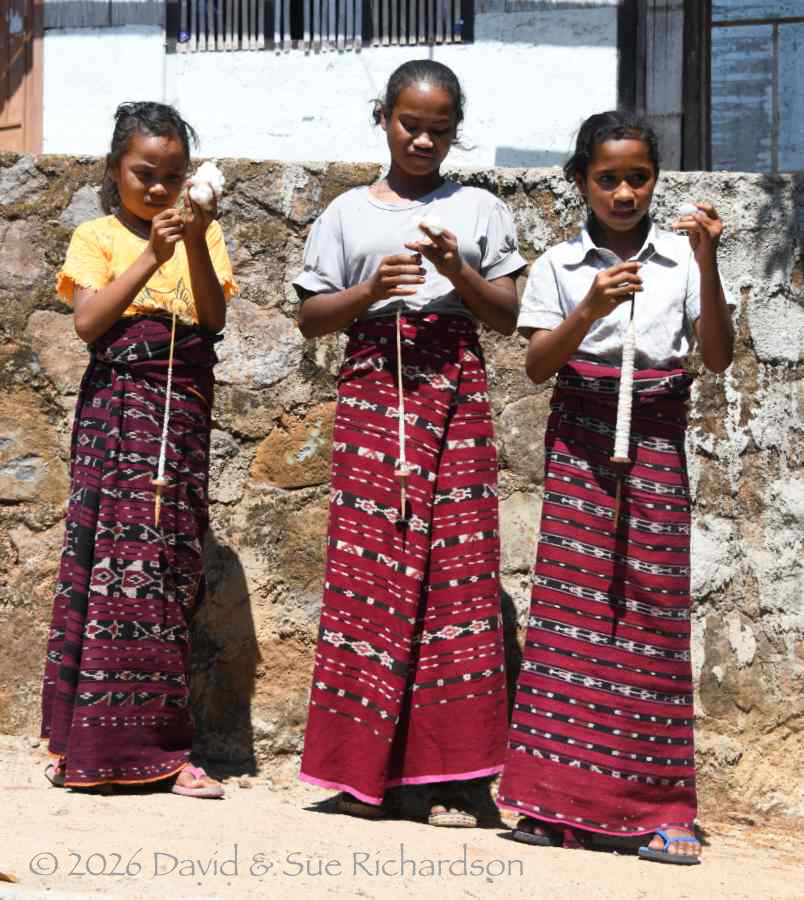
Three young girls drop spinning at Atawolo, from left to right Ina Tukan aged 11, Oti Tukan aged 13 and Ita Tukan aged 11.
Local women informed us that they began to switch to shop-bought yarn around 1980. This is much later than the adoption of commercial cotton in many other places in the Lesser Sunda Islands, probably reflecting the complete lack of pre-colonial and colonial interest in Lembata combined with the region’s relative isolation.
Return to Top
Natural Dyeing
The women of Ata Déi still make a range of natural dyes. As elsewhere in eastern Indonesia, the two primary natural dyes are indigo and morinda.
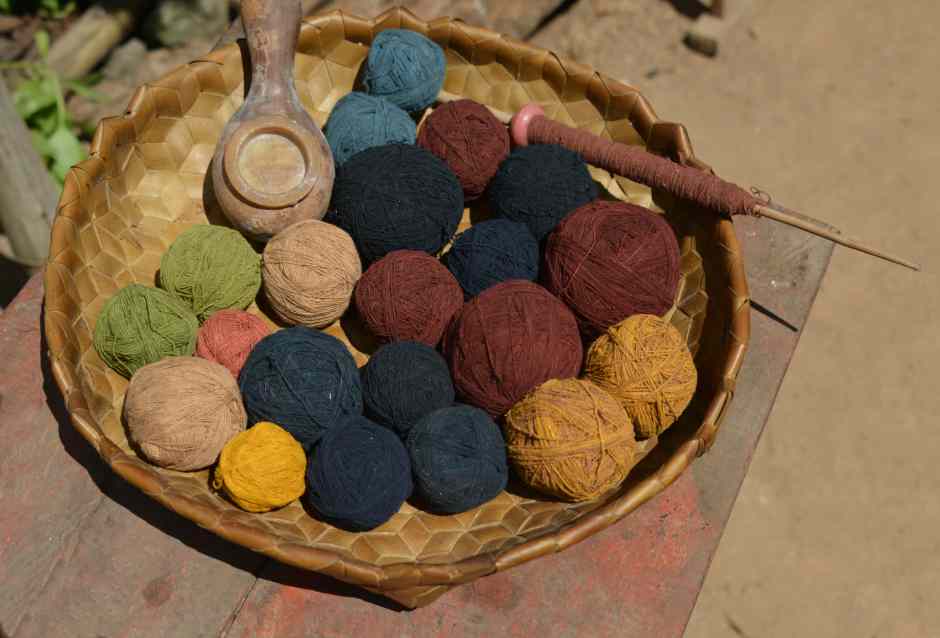
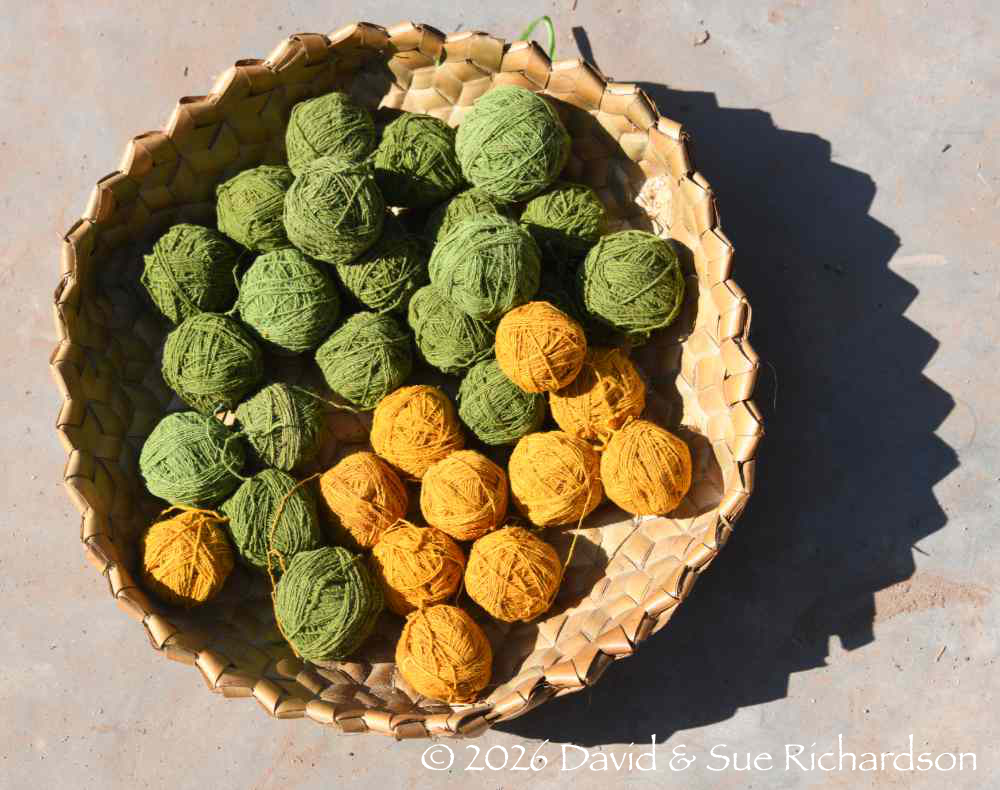
Above: Balls of cotton yarn dyed with a range of natural dyes, mainly indigo and morinda. Below: Balls of cotton yarn dyed with turmeric and a chlorophyl dye.
Indigo, known locally as taum, grows in abundance on the dry coastal slopes of Ata Déi and around the local villages. The dye is prepared in the usual way and is referred to as nila. For more information on indigo click here to visit our dedicated indigo webpage.
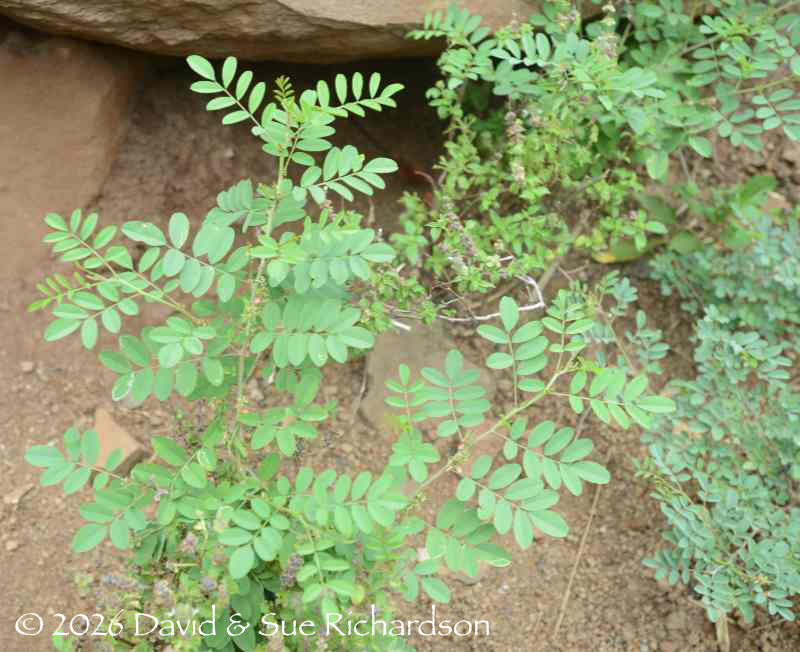
Indigo growing wild on Ata Déi
For traditional sarongs the weft is always dyed indigo blue.
A light Cambridge blue is obtained by just one or two immersions in the indigo dye bath. A near black is achieved from four immersions in indigo followed by six immersions in morinda. In all Ata Déi naturally dyed sarongs the ikatted yarns are first of all dyed numerous times in indigo and later dyed numerous times in morinda. Generally, all of the indigo dyed sections are overdyed with morinda, although there are exceptions. The Lamaholot (and only the Lamaholot) refer to this over-dying process as belapit, which is essential for all bridewealth textiles (Ruth Barnes 1994, 20). Depending on how this is done, it results in a dark grey, near black or purple-brown.
A different light blue dye called pehelemen is obtained from the leaf of a bean plant and alkaline lime powder (kapur). The raw beans are poisonous. To be edible they must first be fried and then soaked in sea water for three to four days.
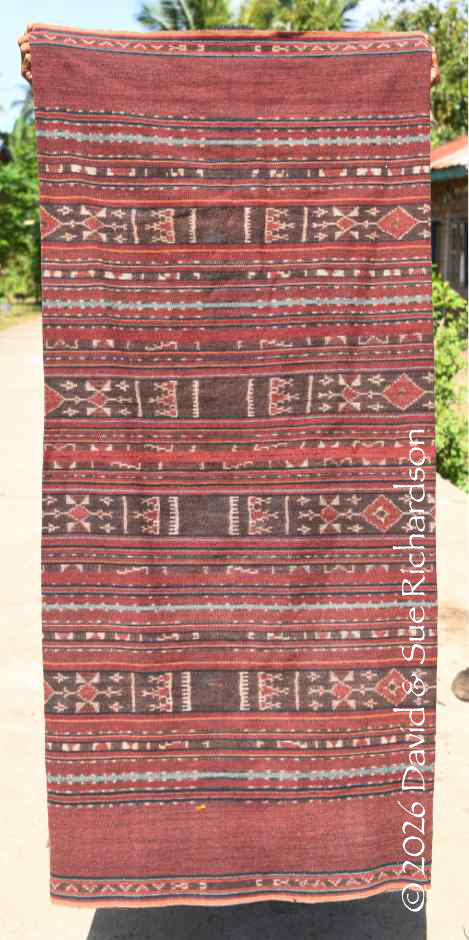
A petak kwae tuan made in Watuwawer by Emiliana Pulo with light blue peheleman stripes
Dyers also create a light turquoise blue from a small grassland plant to which is added a small amount of lime powder.
Morinda is known locally as kloré. Unlike Ilé Apé there is generally no shortage of morinda on Ata Déi. It thrives on the dry coastal slopes of the peninsula, even growing on the sheltered beach below Mulandoro. However, there are variations – the weavers in Watuwawer say that they have plenty of morinda while the weavers in Waiwejak told us that it is getting more difficult to find materials in the forest. In those areas where wild morinda is scarce, the weavers plant it in their gardens around the village.
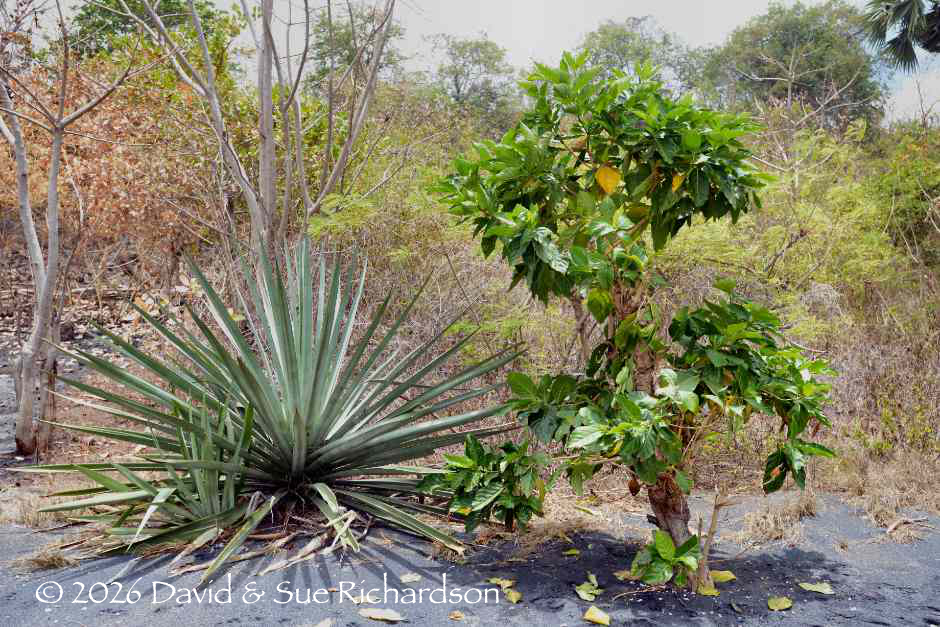
A young morinda tree growing on the beach by Mulandoro. Morinda is primarily propagated by means of ocean dispersal.
However, the roots of these trees do not produce a strong dye. Weavers prefer to harvest roots from trees growing at higher altitudes (presumably the variety M. citrifolia var. bracteata). Today this is much harder to find on the high plateau so the weavers plant it in their gardens around the village. They are careful to only harvest a small amount of the root from each tree.
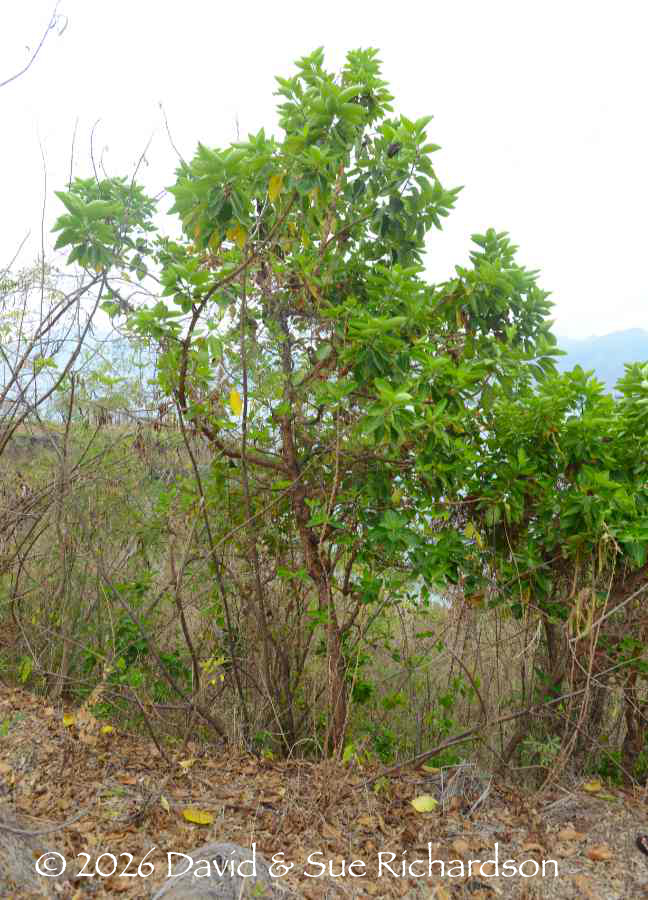
A small morinda tree growing on the Ata Déi Peninsula
To make the morinda dye the weavers need the outer bark of trees belonging to the Symplocos species, which contain the metal mordant aluminium. These trees do not grow on Lembata so the bark is brought to the island by traders from Alor Island. To protect their trade, the traders conceal the identity of the bark by referring to it as koka Alor (koka being the Lamaholot word for bark) or kayu Alor (Alor wood). Prior to the 1979 Ata Déi tsunami there was regular barter trade between Alor and Ata Déi, but today this is more limited.
To obtain pink, dyers immerse their yarns just once in a morinda dye bath. An alternative is to use undyed red cotton. The warp yarns are also dyed once in morinda prior to binding. This is so that the yarn that remains bound through both the indigo and the morinda dyeing stages is not a harsh white, producing a softer effect.
Yellow is obtained from turmeric or kunyit. A mustard-coloured yellow is achieved from four immersions in a bath of pure kunyit, while an orange-yellow is obtained by adding lime powder, kapur, to the kunyit dyebath. To obtain a bright light yellow they add acidic lime juice instead of alkaline lime powder.
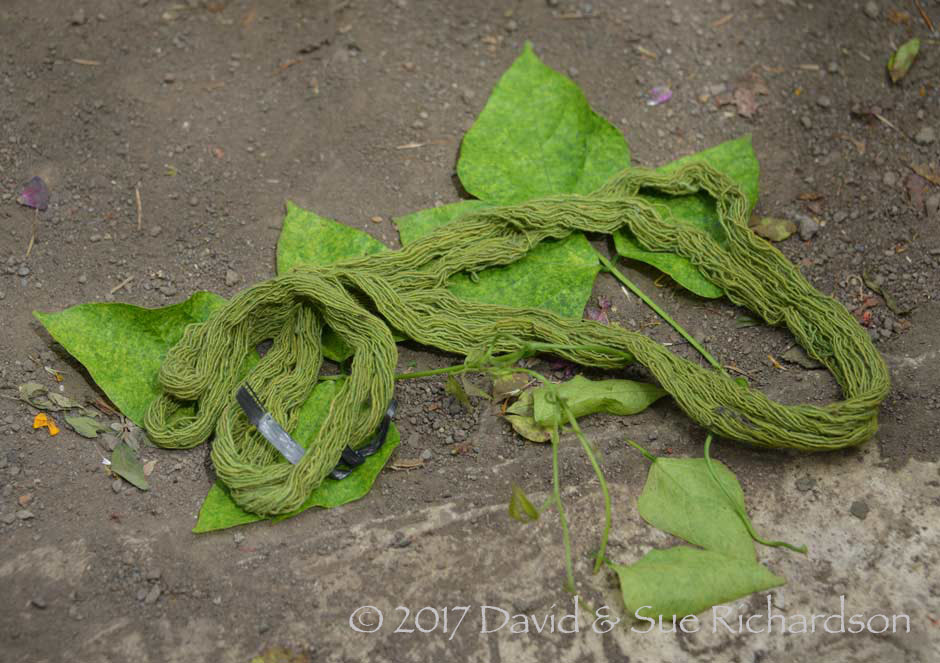
The women of Ata Déi make several interesting green chlorophyl dyes. At Lerek they use the leaf of a climbing vine-like bean that grows in the forest, called utan herani or in Indonesian kacang besar (‘big nut’). The raw beans are poisonous but can be eaten provided they are cooked seven times, ensuring that the water is changed at every stage.
To make a green dye, 30 to 50 leaves are pulped into a liquid and mixed with two glasses of hot water and a very small amount of kapur powdered lime. The dry cotton yarn is immersed in the dye mix and then dried inside the house, shielded from the light. The resulting green will fade quickly in sunlight.
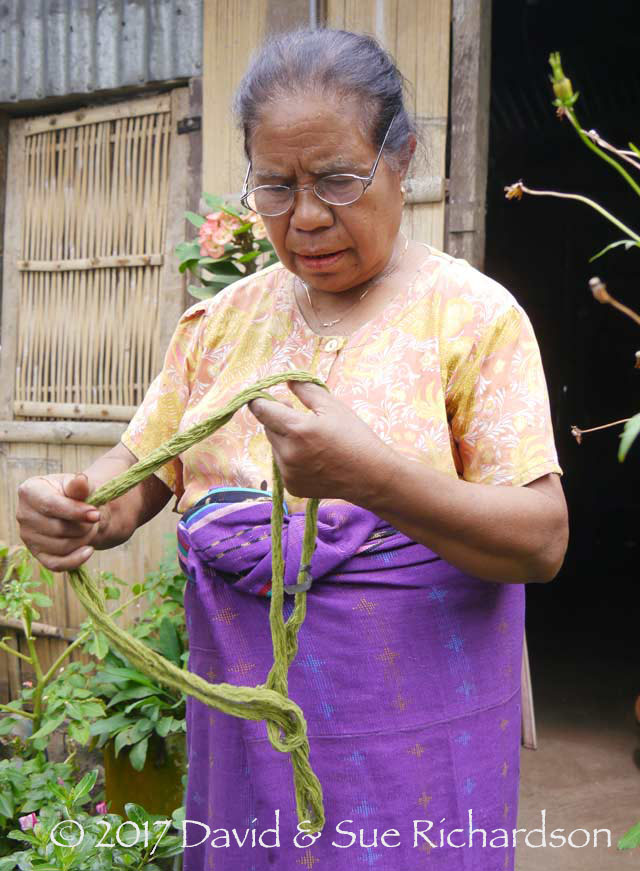
Alberta Jaga Watun at her home in Lerek with a skein of her green dyed cotton
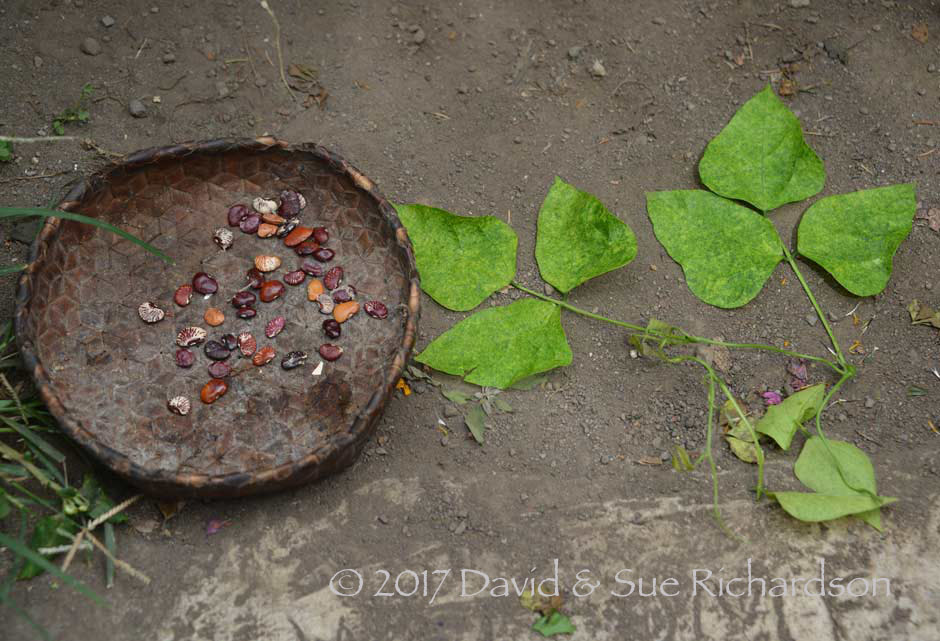
Above: The seeds and mottled green leaves of the utan herani bean
Below: A skein of commercial cotton dyed with utan herani.
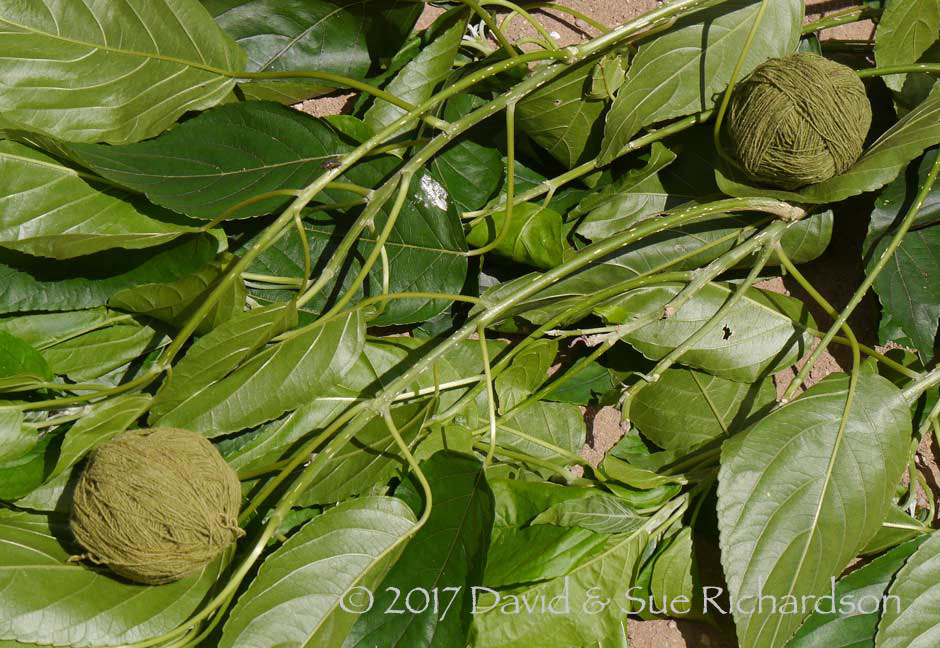
At Watuwater they produce a similar green dye using the leaves of a big tree, locally called kruhi. The pulped leaves are mixed with a little kapur lime powder. The addition of cold water produces a light green colour while the addition of hot water results in a stronger green.
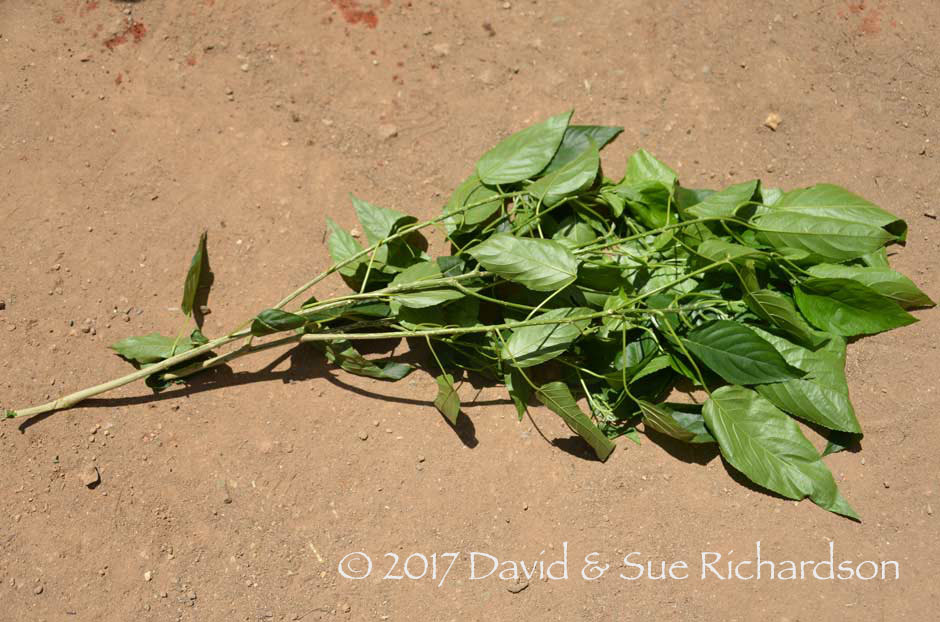
Above: The fresh leaves of the kruhi tree. Below: The ball of cotton yarn on the left has been dyed with kruhi just once while the ball on the right has been dyed with kruhi four times.
Return to Top
Binding and Weaving
Binding, known as puju, is done on a wooden slaga or slagar binding frame. The warps are arranged in bundles of six or eight yarns, known as a kenumak, and these will be grouped to form an ikat band or mata. There must be an odd number of kenumak in each mata to maintain symmetry. It is not permitted to bind another weaver’s motifs or patterns – a woman would go crazy if she attempted to do so.
After she is married, a woman must decide whether to continue binding her mother's motifs or to change and adopt the motifs of her husband’s family. If she decides the latter, there is a special ritual.
Once the ikatted warp yarns have been dyed and unbound they are placed back onto the binding frame so that the motifs can be focussed. Once each ikat band is finished, the warps are locked in alignment by binding them to a short and thin snigi (or sniger) locking stick.
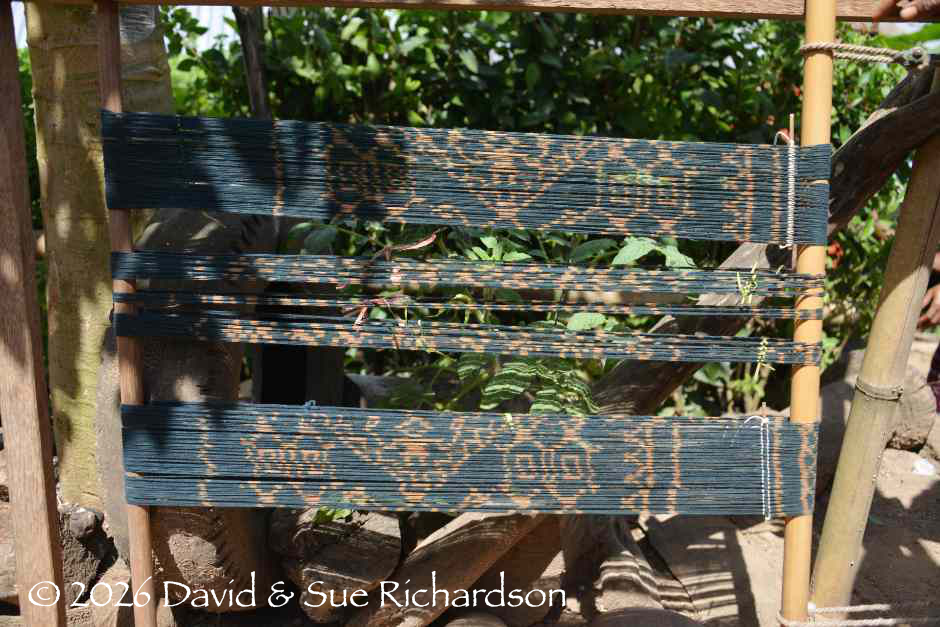
Indigo dyed ikatted mata locked in alignment with short snigi sticks.
Weavers use a rather rustic locally-made back-tension loom that is known as a knékum or kdajang. Some are foot-braced while others are externally braced, the warp beam being fixed to a frame or to part of the house.
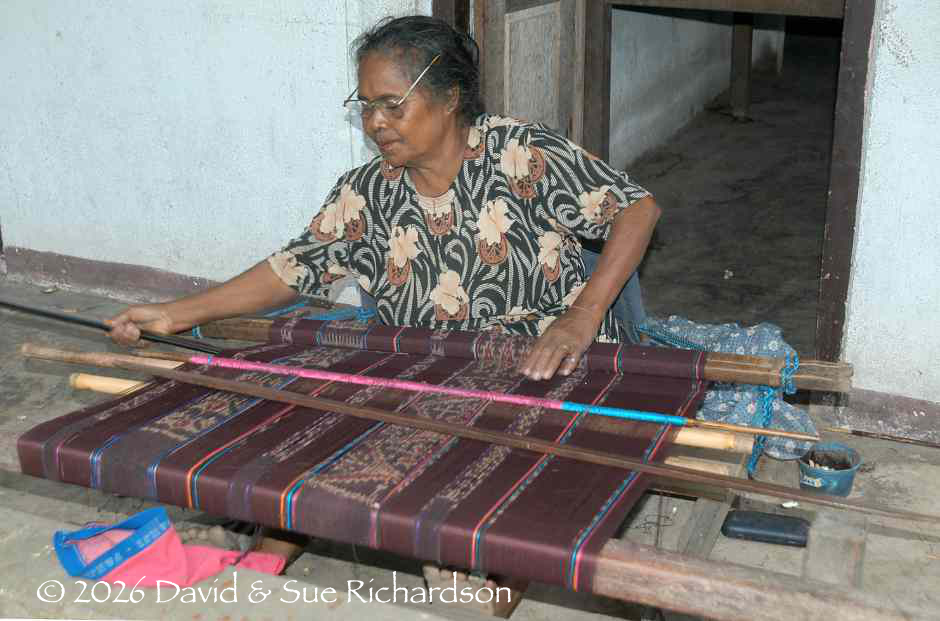
Alberta Jaga Watun with her foot-braced loom outside her house in Lerek in 2004.
Before starting to make an adat petak harén women’s sarong, the weaver must begin by meditating for two weeks prior to the commencement of weaving. She must then sacrifice a red chicken and smear its blood on all of the weaving tools including the drop spindle. If she does not perform this ritual, the sarong will easily break and the weaver will get sick or suffer from insanity. There is no obligation to perform this ritual when weaving a man’s nowin.
The weavers told us that it takes two to three weeks of full-time work to weave one end panel of an adat sarong.
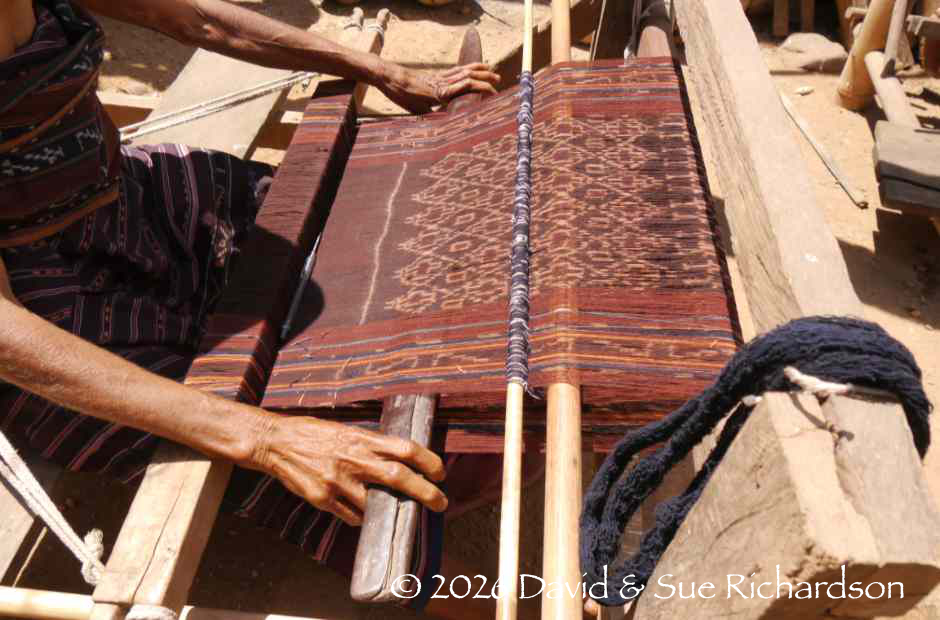
Above: Weaving the central panel of a three-panel sarong on an externally braced loom/ Below: Weaving the end panels of a sarong. Note the home-made construction of the looms.
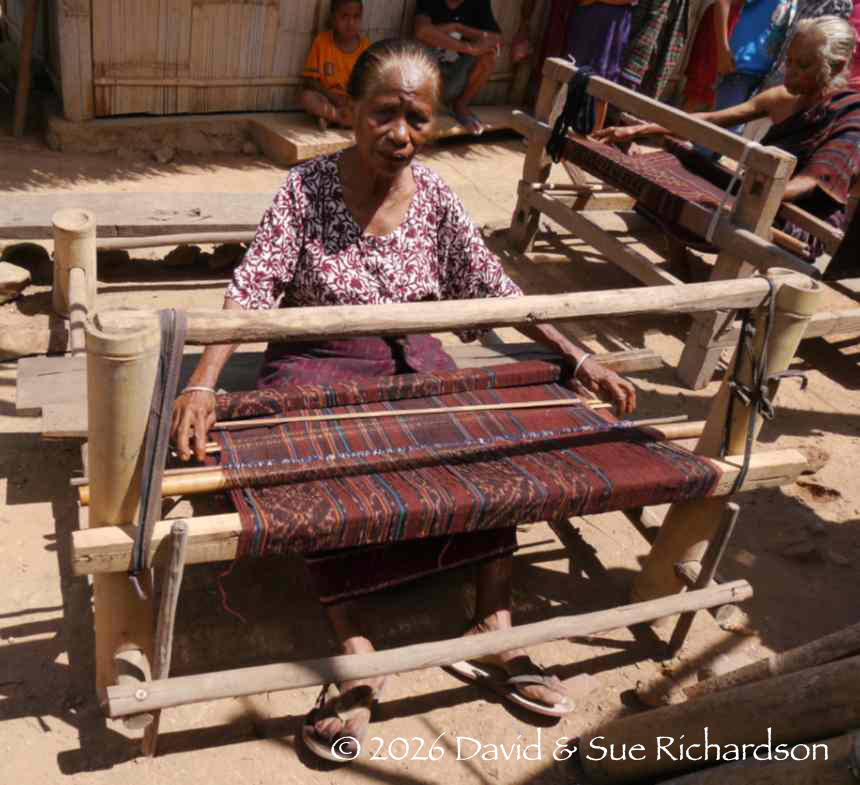
The component parts of a local back-tension loom are as follows:
English |
Ata Déi |
| Loom | Knékum/Kdajang |
| Breast beam | Tnané inan |
| Warp beam | Kébol |
| Yoke | Sligur |
| Heddle stick | Guru |
| Yarn heddle | Gurung |
| Shed stick | Wulo lolon |
| Lease stick | Itit |
| Lease stick | Tamudol |
| Sword | Surit |
| Shuttle | Bloé or Bloér |
| Pick | Nolor |
| Short locking stick | Snigi or Snigér |
| To weave | Tani |
Source: Weavers in Watuwawer and Fricke 2019, 76-80.
Return to Top
Publication
This webpage was published on 20 February 2026.